Communication is the foundation of everything — relationships, learning, independence, safety. For children with autism who are minimally verbal or who find spoken language unreliable, the inability to communicate effectively is not just frustrating; it can drive significant behavioral challenges, anxiety, and isolation. When a child cannot tell you what they need, they find other ways to communicate that message.
Communication boards — and the broader category of augmentative and alternative communication (AAC) that they belong to — give those children a voice. They provide a structured, accessible way to express needs, make choices, and participate in interaction, regardless of where a child currently is in their verbal development. At Autism Centers of Utah, communication boards and AAC tools are integrated into both ABA therapy and speech therapy as part of a coordinated approach to building functional communication.
What Are Communication Boards?
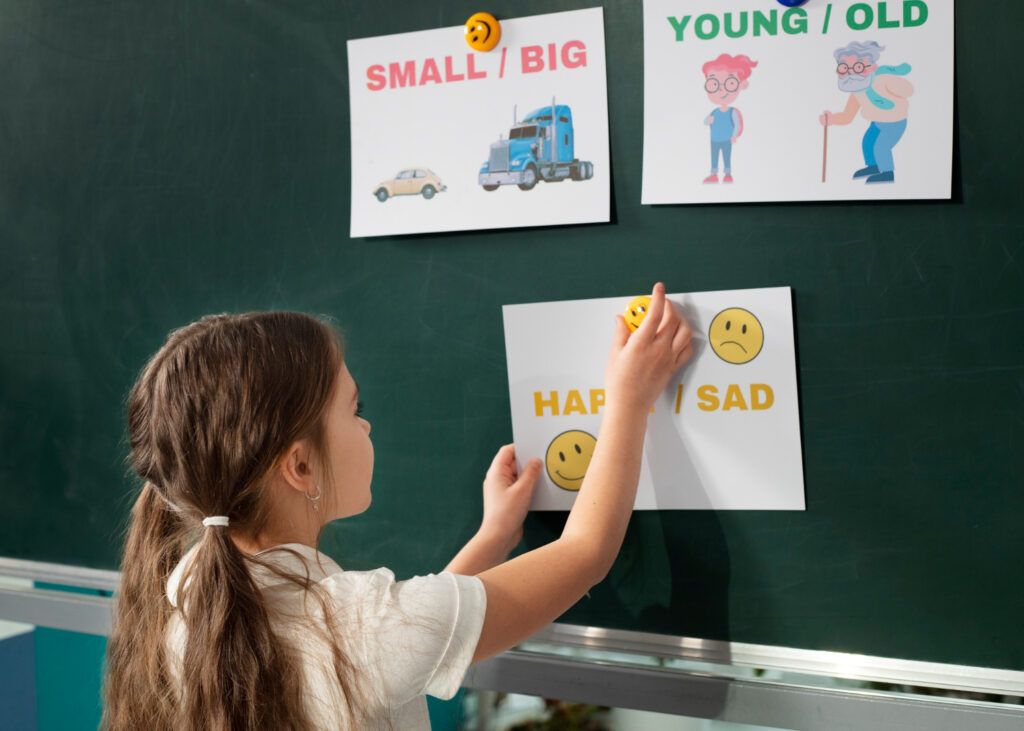
A communication board is a visual tool that uses pictures, symbols, photographs, or text to represent words, requests, emotions, or choices. A child uses the board by pointing to, touching, or exchanging an image to communicate something to a listener.
Communication boards exist on a spectrum of complexity:
- Simple picture boards: A small array of images representing common requests — “eat,” “drink,” “play,” “help,” “break.” These are often the starting point for children who are just beginning to use AAC.
- Symbol-based systems: Standardized symbol libraries like PCS (Picture Communication Symbols) or SymbolStix, used across many apps and printed materials, give children a consistent visual language that can grow with them.
- PECS (Picture Exchange Communication System): A structured protocol in which children learn to physically exchange a picture card with a communication partner to make a request — one of the most evidence-based AAC approaches for young children with autism. PECS is one of several techniques covered in our post on ABA therapy techniques explained: DTT, NET, PECS, and more.
- Digital AAC devices: Apps like Proloquo2Go, TouchChat, or dedicated speech-generating devices (SGDs) allow children to navigate visual symbol grids to construct messages, which the device then speaks aloud. These systems can scale from simple single-message buttons to complex, vocabulary-rich systems capable of supporting full conversation.
The format matters less than the principle: every child with autism who is not reliably communicating verbally deserves access to a system that works for them.
AAC in ABA Therapy at Autism Centers of Utah
In ABA therapy, communication goals are among the most central targets for many children. BCBAs at Autism Centers of Utah design communication programs based on each child’s current verbal repertoire — what sounds, words, or approximations they produce, how they currently communicate needs and preferences, and what the barriers to more flexible communication are.
For children who are minimally verbal, communication boards and AAC devices are often introduced as functional communication tools that allow the child to make requests, respond to questions, and express basic needs — often before verbal speech is reliable or consistent. RBTs implement communication goals directly in sessions, using techniques such as:
Functional communication training (FCT): Teaching a child a specific, efficient way to communicate a need that previously drove a challenging behavior. If a child was hitting when they wanted a break, FCT teaches them to use a picture card, a device, or a gesture to request that break instead. The communication replaces the behavior because it is more efficient at getting the same result.
Naturalistic teaching: Embedding communication opportunities into play and daily activities so that the child practices making requests, labeling items, and responding in contexts that feel meaningful rather than clinical.
Discrete trial training: Structured, repeated practice of specific communication behaviors — touching a named picture, selecting the correct symbol, imitating a word — to build the foundational skills that support more flexible communication later.
Communication Boards in Speech Therapy
Autism Centers of Utah offers speech therapy for ABA clients whose treatment plans include it. Speech therapists work alongside BCBAs and RBTs, coordinating goals so that communication strategies are consistent across both disciplines. In speech therapy, communication boards and AAC tools are used to:
- Assess a child’s language comprehension and expressive abilities across modalities
- Model AAC use — the speech therapist regularly demonstrates using the communication board or device themselves, not just prompting the child to use it
- Expand vocabulary within AAC systems as the child demonstrates readiness for more complex communication
- Support the development of multi-word combinations and more complex sentence structures within AAC
Because speech therapists and ABA therapists work in the same facility and communicate directly, goals are aligned and strategies are shared. A child learns the same vocabulary and the same system in both contexts, which accelerates learning and generalization.
Does AAC Prevent Children from Developing Speech?
This is one of the most common concerns parents raise, and the research is unambiguous: AAC does not delay or suppress the development of spoken language. Multiple studies have found the opposite — children who use AAC often show gains in verbal speech, possibly because the system reduces communication frustration, gives children a model for language structure, and provides a scaffolding effect for verbal attempts.
The goal of introducing AAC is not to replace speech as a long-term outcome — it is to give a child a reliable way to communicate right now, which reduces frustration and opens up more opportunities for learning. Token systems are another visual tool that pairs well with AAC in building structured engagement — read about how token systems motivate children during ABA sessions for more detail. Some children who begin with AAC develop robust verbal speech and reduce their reliance on the device over time. Others continue to use AAC as their primary communication modality throughout their lives. Both paths are valid. What matters is that the child can communicate.
How Parents Can Use Communication Boards at Home
The most effective AAC use happens when communication boards and devices are available and used consistently across all of a child’s environments — not just in therapy. Here is how families can make communication boards part of daily life at home:
Keep the board accessible. A communication board that is in a drawer is not useful. Post it on the refrigerator, keep it at the table during meals, or use the app on a tablet that stays in common areas. The easier it is to reach, the more opportunities a child has to use it.
Model using the board yourself. One of the most powerful things a caregiver can do is touch symbols on the communication board while talking — “Do you want to [touches ‘eat’ symbol] eat?” or “Time to [touches ‘play’ symbol] play.” This is called aided language stimulation, and it teaches children how to use the system without requiring them to perform on demand.
Respond to every communication attempt. When a child touches a symbol — even imprecisely, even with prompting — respond as though they have successfully communicated. Give the requested item, acknowledge the expressed feeling, or respond to the question. This teaches the child that the board works, which is what motivates continued use.
Expand vocabulary gradually. Work with your child’s speech therapist or BCBA to identify which new vocabulary items to add to the board. Adding too many symbols at once can be overwhelming; adding them strategically as the child demonstrates readiness is more effective.
Do not remove AAC to “force” speech. Some families worry that if they always make the board available, their child will not be motivated to speak. This is a concern worth raising with your child’s speech therapist, but the evidence does not support withholding AAC access. Providing access and modeling robust use gives children the best chance of developing both AAC and verbal communication skills.
Frequently Asked Questions
At what age can a child start using a communication board?
There is no minimum age for introducing AAC. Children as young as 12 to 18 months have been successfully introduced to picture-based communication systems. The principle is that communication is always the goal, and the earlier a child has access to a reliable way to communicate, the better.
How do I know if my child needs AAC or if we should focus on verbal speech first?
This is a question for your child’s BCBA and speech therapist to assess. If a child is not yet communicating reliably — regardless of how many words they have — introducing a supported communication system is typically appropriate. The two approaches are not mutually exclusive.
What if my child refuses to use the communication board?
Refusal or disinterest is common at first, especially if the board has been introduced in a demanding or pressured way. Effective introduction involves modeling without demand, using the board in motivating contexts, and allowing the child to observe it being used without being required to perform. Discuss this with your child’s therapist if resistance persists.
Will the school use the same communication system as Autism Centers of Utah?
Coordination between therapy and school is ideal. Discuss with your child’s BCBA and speech therapist what the school is currently using and whether a consistent system can be established across settings. Sharing strategies with school teams is part of how generalization is supported.
Is AAC covered by insurance?
Speech therapy services, which include AAC assessment and implementation, are typically covered when prescribed as part of a treatment plan. Autism Centers of Utah is in-network with Blue Cross Blue Shield and Utah Medicaid. Dedicated AAC devices may require a separate prior authorization — the team can help families navigate that process.
If your child is in Sandy, Midvale, or anywhere in the greater Salt Lake area and you have questions about communication boards, AAC, or how Autism Centers of Utah supports communication development in our ABA and speech therapy programs, call us at (385) 417-3869. Every child deserves a way to be heard.